


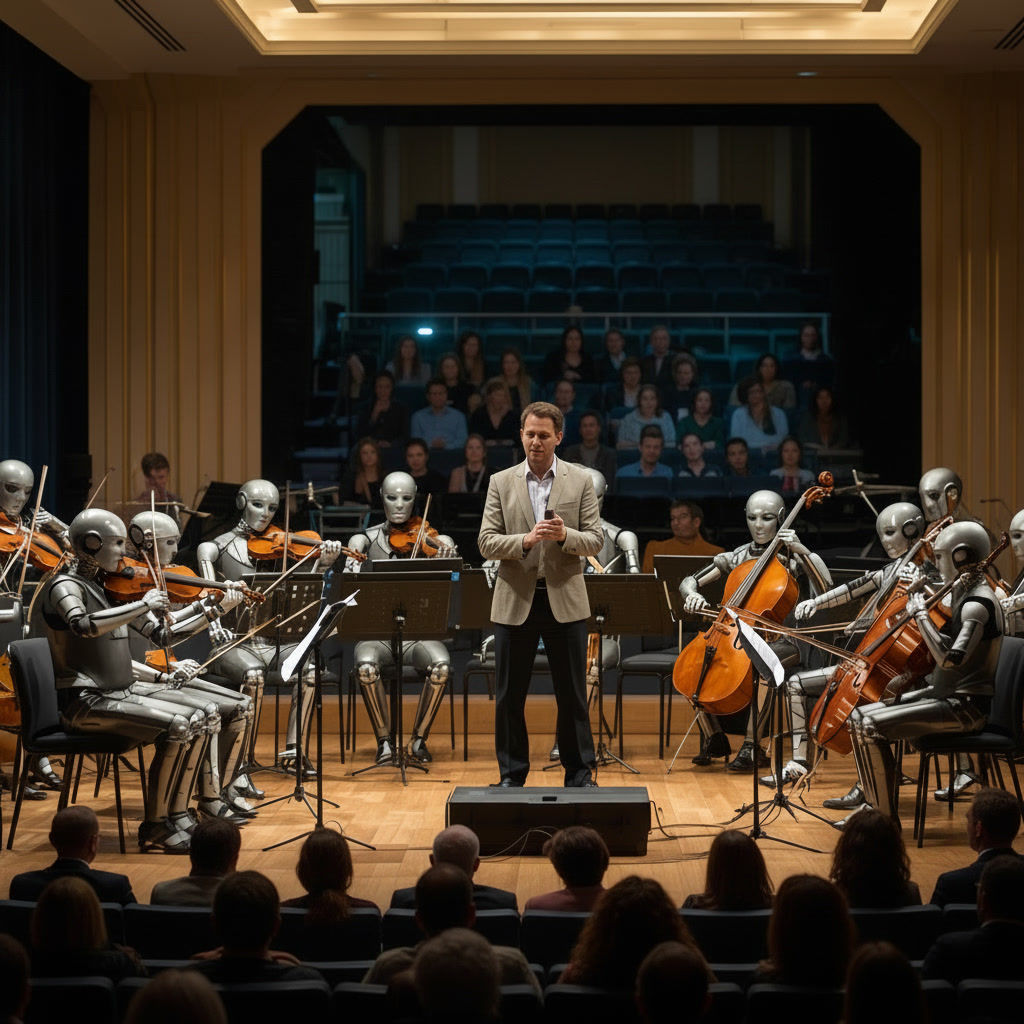
Today I felt like talking about a topic that really got me thinking: the use of A.I. in music.
Last week, a friend of mine invited me out for a evening drink. We met up, made small talk, and then he asked me how my music was going—though it was really just an excuse to tell me that he had started composing too, using an app called Suno! He explained how he uses it, how it works, and he was super excited because he’s able to “compose” songs he would have never dreamed of making. You input the genre, describe the song structure and the subject matter, select how many voices you want, choose whether there are screamed or melodic parts and where to place them, and then Suno processes everything. I thought he had recorded the vocals himself using pitch correction… but nope, those were created by Suno too.
He played a few tracks for me, and I have to admit everything was well-made and crisp. Occasionally the voice might glitch or the lyrics might use redundant words and rhymes, but I liked it. And as much as it rubbed me the wrong way, I can’t even say he’s entirely wrong in feeling like a composer. Sure, an ignorant and mediocre composer using A.I., but he can still call himself one. He might not be communicating every single detail to the A.I. note for note—using specific directives in some cases and generic ones in others—but what comes out is something that he and the A.I. generated together.
The thing that really got under my skin, though, was this: why does my friend feel like he’s a composer just like me? Words have weight, and after asking how my music was going, he told me he had gotten into composition too, effectively placing himself in my field. Was it just ignorance? Does he not realize how much time it takes to find riffs, put them together, arrange a track, and record all the parts, only to then craft lyrics and record a fitting vocal line? That might be it, but in the moment I felt offended—like all the work I’ve put in so far was being trivialized yet again for no reason.
I’ve used Leonardo.ai recently to generate cover art for my third album coming out next year, but I’ve never considered myself a graphic designer. I know full well that a professional designer would have exploited that same platform far better than I did. My only goal was to make covers that popped even as tiny icons, so I didn’t obsess over sharpness or other technical parameters a designer would spot.
Bitterness aside, though, it brought up another point worth reflecting on: people who use these programs still need the fundamentals of composition! Listening to my friend’s songs, I noticed several missteps in how he structured the tracks, wrote the lyrics, and picked the titles.
Structure Sometimes, right at the end of the first verse, the dynamic and epic build-up (these were all power metal tracks) was so intense that I expected a glorious chorus entrance. Instead, it threw me right into a second verse, deflating the whole thing. A highly questionable choice, just like changing the words in the chorus—an approach I see as much more Asian/Japanese. Maybe I’m just closed-minded, but a chorus needs to repeat (in Italian, ritornello) because it’s the part you immediately associate with the title; it’s what makes you remember the song. It’s the damn soul! Sure, if you’re telling a story, you can change chorus lyrics, but in a power metal track, I wouldn’t do it unless the instrumental part makes it crystal clear that we’ve entered the chorus.
Song Titles Then there are the titles… I get the urge to name songs like you’re titling book chapters, but take “Nel blu dipinto di blu,” for example—it’s widely agreed it would have been more accurate to title it “Volare,” because you associate it instantly! Based on my experience, there are a few main ways to pick a title:
- The general theme: Romantic, but risky for instant association if the phrase isn’t actually sung in the lyrics.
- The first line of the vocal track: In fast, driving tracks, the opening line sometimes lets you remember the whole song in sequence. Very easy to associate.
- The first line of the chorus: Entering the chorus gives you immediate recognition. Listeners might struggle to recall what comes before, but reading the title brings the core of the song right back to mind.
- The last line of the chorus: Like I did on “Their Last Breath.” It works because you resolve back into the main riff, then into the verse, leading straight into the second chorus, the bridge, and the final chorus. It anchors the track nicely.
- The very last line of the lyrics: I’d use an iconic phrase that encapsulates the essence of the lyrics—something that leaves a sense of curiosity or uses a unique rhythm. It forces a mental association that burns into the listener’s mind like a brand. You break linear phrasing with a different accent pattern than how they’d normally read or sing it, pushing the listener to think, “What the hell did they just do there?” It forces them to replay even just the ending to own that interpretation. Plus, using the final line can keep listeners glued to the track until they finally hear the title phrase dropped!
I will never use Suno or other A.I. platforms or apps to compose music, because in my head there’s always the hope of performing live sooner or later. I don’t want to command an A.I. to give me solos in E in the style of Adrian Smith or Dave Murray if they aren’t within my skillset and I wouldn’t know how to play them live. So, I prefer doing just a couple of simple notes that I can actually replicate rather than impressive feats that aren’t really mine—that’s all.
Anyway, back to my daily stress. Talk to you later!